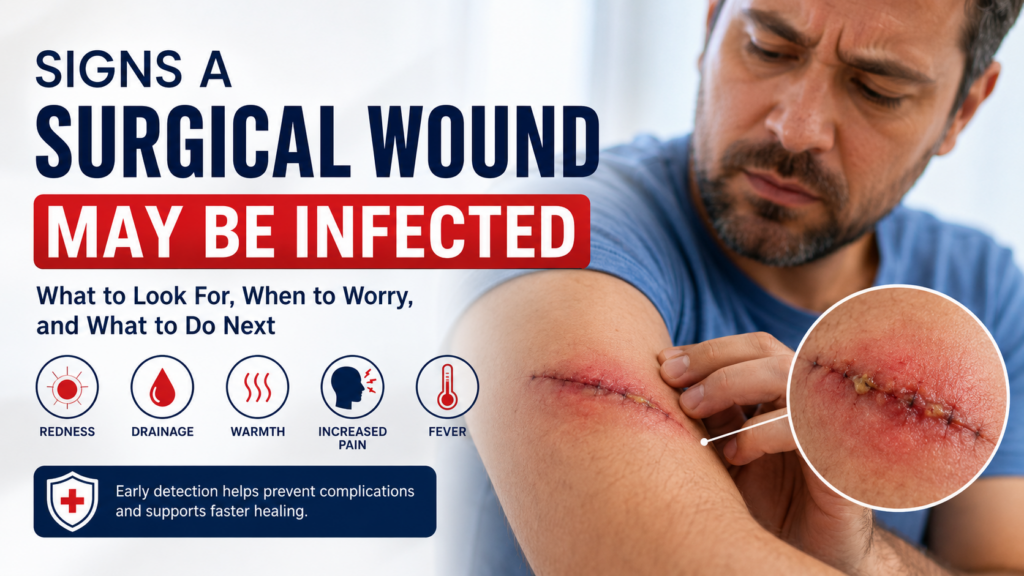
A surgical wound may be infected if the incision becomes increasingly red, swollen, hot, painful, or starts draining cloudy fluid or pus. Fever, feeling unwell, worsening pain, or the wound opening are also warning signs that need medical attention.
A small amount of soreness, mild swelling, and some redness can be part of normal healing after surgery. The concern is change: symptoms that get worse instead of better, spread beyond the incision, or appear with fever or pus.
This guide explains the signs of a possible surgical wound infection, how infection differs from normal healing, when to call your surgeon, and when to seek emergency help. It is educational and does not replace advice from your surgical team.
The main signs a surgical wound may be infected are redness, increasing pain, warmth, swelling, pus-like drainage, fever, feeling generally unwell, delayed healing, or the wound opening. The CDC lists redness and pain around the surgery area, cloudy fluid from the wound, and fever as common surgical site infection symptoms.
Watch for these warning signs:
MedlinePlus also notes that surgical wound infections may drain pus and may be red, painful, or hot to the touch, with fever or feeling sick also possible.
Infected surgical wound drainage is often thick, opaque, milky, yellow, green, or pus-like. The CDC’s NHSN guidance describes purulent drainage using features such as green or yellow color and thick, creamy, opaque, or viscous consistency.
Not every fluid from a wound means infection. A healing wound may release some fluid, especially early in recovery. The concern is drainage that becomes:
A simple rule: clear or lightly blood-tinged fluid that decreases over time is less concerning than thick, colored, increasing, or pus-like drainage. Still, any new or concerning drainage after surgery should be reported to the surgical team.
Redness is concerning when it spreads, becomes brighter, feels hot, becomes painful, or appears with swelling, pus, fever, or feeling unwell. Mild redness can happen during healing, but spreading redness can suggest inflammation or infection.
University Hospitals Sussex describes mild redness, warmth, swelling, and discomfort as possible normal healing signs when they reduce over time; signs of infection include spreading redness, increased heat, increased swelling, increased or new pain, and increased fluid leakage.
Redness is more suspicious when:
Do not ignore spreading redness after surgery. It may be an early sign that bacteria are moving into surrounding skin.
Pain may suggest infection when it gets worse after initially improving, becomes sharp or throbbing, spreads beyond the incision, or appears with redness, swelling, warmth, drainage, or fever. Normal postoperative pain should generally become easier to control as healing progresses.
The CDC’s NHSN FAQ explains that new or worsening pain can mean pain that returns after improving, pain that increases on a pain scale, or pain that changes in type, character, frequency, or impact on daily function.
Pain is more concerning when:
Pain alone does not prove infection. But worsening pain is a reason to contact your healthcare provider, especially after surgery.
Normal surgical wound healing usually improves over time, while infection usually worsens or adds new symptoms such as spreading redness, pus, heat, fever, or increasing pain. MedlinePlus notes that some pain, swelling, and soreness around the surgeon’s cut can be expected after surgery, but infection is a possible complication.
| Symptom | More Consistent With Normal Healing | More Concerning for Infection |
|---|---|---|
| Redness | Mild redness near incision that fades | Redness spreading outward or getting brighter |
| Swelling | Mild swelling that improves | Increasing swelling, tightness, or puffiness |
| Warmth | Mild warmth that reduces | Hot skin around the wound |
| Pain | Pain gradually improving | Pain worsening, returning, or becoming throbbing |
| Drainage | Small amount of fluid that decreases | Thick, cloudy, yellow, green, or pus-like drainage |
| General symptoms | Feeling tired after surgery but improving | Fever, chills, weakness, or feeling sick |
| Wound edges | Edges staying closed | Wound opening or pulling apart |
| Healing trend | Wound looks better each day | Wound looks worse or stops healing |
NICE defines surgical wound infection as a wound with local signs such as heat, redness, pain, and swelling, and more serious cases may include fever or raised white blood cell count. NICE also notes that infection may prevent healing, cause wound edges to separate, or form an abscess in deeper tissues.
Most surgical wound infections appear within the first 30 days after surgery, but timing depends on the procedure and whether an implant was placed. MedlinePlus states that most surgical wound infections show up within the first 30 days after surgery.
Some infections appear earlier. Guy’s and St Thomas’ NHS Foundation Trust says a surgical wound infection can happen from 2 to 3 days after surgery until the wound has healed, usually 2 to 3 weeks after the operation; infections can sometimes happen months later.
Timing matters because patients often assume they are “past the danger period” too early. Watch the wound closely until it is fully healed, and follow your surgeon’s instructions for any longer monitoring period after implant surgery.
Surgical site infection rates vary widely by surgery type, patient risk, hospital setting, and surveillance method. A 2023 global systematic review reported a pooled surgical site infection incidence of 2.5%, while ECDC surveillance data for 2023 found SSI percentages ranging from 0.4% in laminectomies to 10.2% in open colon surgery among reported procedure types.
This means the risk is not the same for every operation. A clean, short procedure in a healthy patient is not comparable to emergency abdominal surgery, bowel surgery, or surgery in a patient with diabetes, smoking history, immune suppression, or poor nutrition.
The practical takeaway is simple: most patients do not develop a surgical wound infection, but early recognition matters because treatment is easier before infection spreads.
Surgical wound infections can affect the skin, deeper tissues, organs, spaces inside the body, or implanted material. The CDC states that surgical site infections can occur in skin, tissue, organs, or implanted material such as a hip replacement.
MedlinePlus groups surgical wound infections into three levels: superficial, deep, and organ/space infections.
A superficial incisional infection affects the skin and tissue near the incision. This is often the type patients notice first because it can cause visible redness, warmth, swelling, tenderness, and drainage.
Possible signs include:
Superficial infections still need medical attention. They can worsen or spread if ignored.
A deep incisional infection goes below the skin into deeper soft tissue such as fascia or muscle. This type may cause deeper pain, fever, wound opening, pus drainage, or a tender area beneath the incision.
Deep infections can be harder to judge at home because the surface may not show the full problem. Worsening pain, fever, or a wound that opens should be reported quickly.
An organ/space infection affects an internal organ or body space involved in the operation. This type may cause fever, increasing pain, fatigue, drainage, or symptoms related to the operated area.
For example, after abdominal surgery, symptoms may include worsening abdominal pain, fever, or feeling seriously unwell. Organ/space infections require medical evaluation and may need imaging, drainage, antibiotics, or another procedure.
Call your surgeon, hospital team, or healthcare provider promptly if you notice redness and pain at the surgery site, drainage, fever, wound opening, or any symptom that is getting worse instead of better. The CDC advises calling a healthcare provider immediately if symptoms such as redness and pain at the surgery site, drainage, or fever occur once you are home.
You should contact a clinician if:
Guy’s and St Thomas’ NHS Foundation Trust advises contacting the hospital doctor or GP straight away if wound infection symptoms appear, because early treatment helps stop infection from getting worse.
A surgical wound infection may be an emergency if it appears with confusion, shortness of breath, severe pain, clammy skin, fast heart rate, weak pulse, fever with shivering, or feeling very cold. These can be signs of sepsis, which the CDC describes as a life-threatening medical emergency caused by the body’s extreme response to infection.
Seek urgent or emergency medical care if you have:
University Hospitals Sussex also lists serious infection symptoms such as confusion, severe breathlessness, reduced urination, loss of consciousness, fever or low body temperature, fast heartbeat, fast breathing, chills, and dizziness, and states that sepsis requires immediate treatment.
A surgical wound becomes infected when harmful germs enter the incision and multiply in the wound or deeper tissues. MedlinePlus explains that germs may come from the skin, from inside the body or the operated organ, or from the surrounding environment.
Johns Hopkins Medicine identifies common bacteria involved in surgical site infections, including Staphylococcus, Streptococcus, and Pseudomonas. It also explains that germs can enter through contact with contaminated hands or instruments, germs in the air, or germs already on or in the body.
Common sources include:
This is why hand hygiene, sterile dressings, and following discharge instructions matter. Surgical wounds are healing tissue, not ordinary scratches.
People with diabetes, obesity, smoking history, immune system problems, steroid use, poor nutrition, longer operations, emergency surgery, abdominal surgery, or contaminated wounds have a higher risk of surgical wound infection. MedlinePlus lists poorly controlled diabetes, immune problems, overweight or obesity, smoking, corticosteroid use, long surgery, and some surgery types as risk factors.
Johns Hopkins Medicine also lists risk factors including surgery lasting more than 2 hours, other medical problems, older age, being overweight, smoking, cancer, weak immune system, diabetes, emergency surgery, and abdominal surgery.
Higher-risk groups include people who:
Risk factors do not mean infection will happen. They mean symptoms deserve faster attention.
Infected surgical wounds are usually diagnosed by examining the wound, reviewing symptoms, and sometimes testing wound fluid or tissue. Treatment may include antibiotics, wound care, drainage, or another procedure depending on the depth and severity of infection.
MedlinePlus states that antibiotics are used to treat most wound infections and that surgery may sometimes be needed. It also notes that antibiotics may be given intravenously first and then changed to pills depending on the case.
Diagnosis may include:
Treatment may include:
Guy’s and St Thomas’ NHS Foundation Trust notes that if clinicians suspect a surgical wound infection, they may take a swab from the wound surface for laboratory testing and may treat with antibiotics.
You can reduce the risk of surgical wound infection by keeping hands clean, avoiding unnecessary wound touching, following dressing instructions, not shaving near the surgical area, managing health conditions, and contacting your care team early if symptoms appear. The CDC recommends hand cleaning before and after wound care, keeping family and friends from touching the surgical wound or dressings, and asking healthcare providers to clean their hands if needed.
Practical prevention steps include:
The CDC also advises telling providers about medical problems such as diabetes and obesity, quitting smoking before surgery, and not shaving near the surgery site because razor irritation can make infection easier.
Common mistakes include assuming worsening symptoms are normal, waiting for pus before calling, covering up symptoms with leftover antibiotics, touching the wound with unwashed hands, or missing follow-up appointments. These behaviors delay care and can let infection spread.
Avoid these mistakes:
The blunt truth: if a surgical wound is getting worse instead of better, pretending it is “probably fine” is poor judgment. Call the surgical team.
The key takeaway is that infection is more likely when a surgical wound becomes increasingly red, swollen, hot, painful, draining pus, opening, or appears with fever or feeling unwell. Normal healing should generally move toward less pain, less swelling, and better closure over time.
Use this simple action rule:
The first sign is often worsening redness, pain, warmth, or swelling around the incision. Pus, cloudy drainage, fever, or feeling unwell can also appear.
No. Mild redness can be part of healing. Redness is more concerning when it spreads, gets hotter, becomes painful, or appears with swelling, pus, fever, or worsening drainage.
Yellow drainage can be harmless in small amounts if it is thin and decreasing, but thick yellow or green pus-like drainage can suggest infection. Contact your surgical team if drainage changes, increases, smells bad, or appears with pain or fever.
Some very mild wound problems may improve with proper wound care, but a true surgical wound infection often needs medical evaluation and may require antibiotics or drainage. Do not self-diagnose after surgery.
Worry about pain that gets worse after improving, becomes severe, changes character, or appears with redness, swelling, heat, drainage, fever, or wound opening.
Cover the area with a clean dressing and contact your surgeon or healthcare provider promptly. If the wound opens widely, tissue is visible, or you feel very unwell, seek urgent care.
Many surgical wound infections appear within 30 days, but some can occur earlier within the first few days or later, especially when implanted material is involved.
Contact your surgeon, hospital discharge number, GP, or urgent care service. A quick check is safer than waiting until infection becomes harder to treat.
If you are worried that a surgical wound may be infected, do not wait for symptoms to get worse. Ajmedicus provides primary care and wound care services in Bullhead City, Arizona, including wound evaluation, infection management, diabetic wound care, and advanced healing support.
For personalized medical guidance, schedule a visit with Ajmedicus at 1467 Palma Rd #4, Bullhead City, AZ 86442 or call 928-296-9064. Same-day appointments may be available for wound care concerns.
Book an appointment with Ajmedicus today and get your wound checked by a local medical team focused on safe healing and patient-centered care.